eClinicalWorks
Same day appointments in eClinicalWorks: calls to bookings
healow books routine visits, but same-day callers still need a person. Here’s how eClinicalWorks practices close that gap today.
Key takeaways
- healow Open Access publishes schedule slots for patients already on a screen, but it cannot answer a ringing phone or triage a caller who needs a slot.
- An MGMA Stat poll of 294 practice leaders found 36% of practices said at least 11% of calls go unanswered or reach voicemail during peak hours.
- Creating a dedicated same-day appointment type in eClinicalWorks lets 2care.ai’s voice agent match urgent callers to the right slot type without staff touching the schedule.
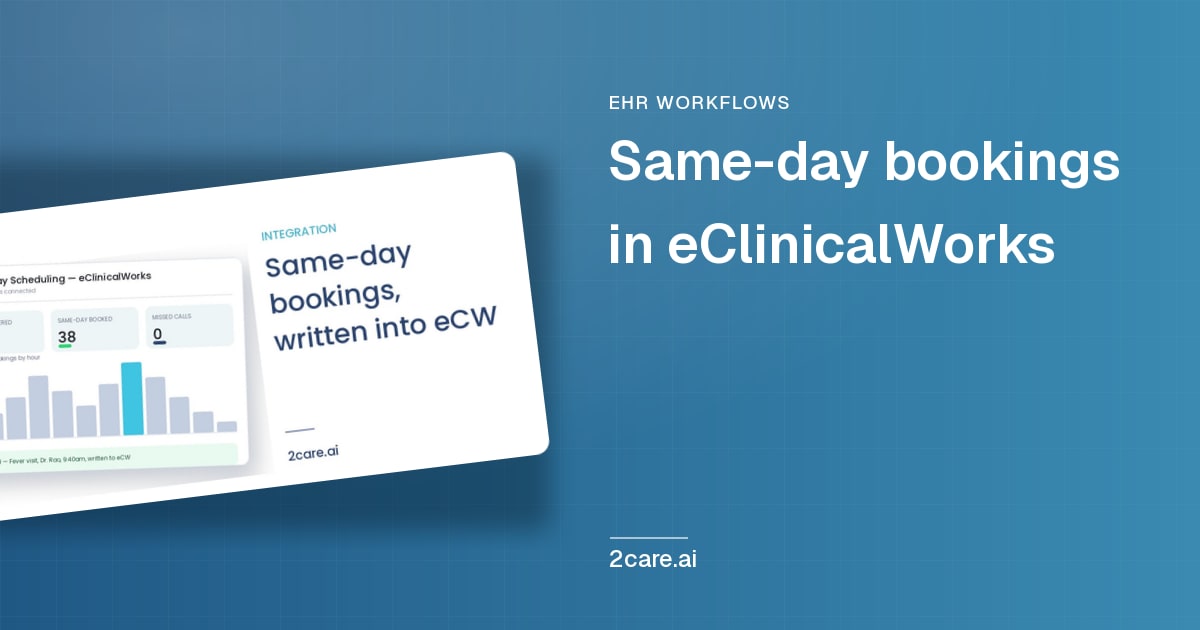
- 2care.ai’s voice agent reads a practice’s open eClinicalWorks slots through the healow Open Access API and writes same-day bookings straight back into the schedule.
- Experian Health found 63% of providers offered online self-scheduling in 2024, up from 40% in 2022, almost entirely for routine visits booked in advance.
A patient calls at 8:04am with a child running a fever. The front desk is checking in the first three arrivals of the day. The call rolls to voicemail, the parent hangs up without leaving one, and by 8:20am they have booked at urgent care down the street instead. Nothing in eClinicalWorks recorded that this happened; the system only ever saw a schedule that stayed open all morning.
eClinicalWorks does not turn a ringing phone into a same-day booking on its own. healow Open Access publishes slots for patients who are already looking at a screen, but a caller with a same-day problem still needs someone to pick up, find an appropriate slot, and write it back into eCW before the line rings again.
Why healow Open Access was not built for the same-day caller
healow Open Access is a self-service tool. A patient logs into the portal, the app, or a practice's booking widget, sees whichever slots the practice has published, and books one directly. eClinicalWorks has publicly reported this working well for routine volume: one new practice filled its schedule from January through June 2023 with more than 90% of appointments booked through the Open Access link, and another primary care practice built its workflow almost entirely around the same self-scheduling model.
None of that depends on anyone answering a phone, which is the real limit. A same-day caller reacts to something happening right now: a fever, a sprained ankle, a medication running out. The fastest path to a slot still runs through a live conversation. Open Access exists to pull routine bookings out of the phone queue, and it stops there.
What a same-day caller needs from eClinicalWorks
A same-day request needs three things a routine booking usually doesn't: an answer right now, a person or an agent who can judge whether the visit qualifies as same-day, and a real open slot behind that judgment. eClinicalWorks can support all three when the schedule is configured to make them fast.
That means a visit type a scheduler can search for directly, provider templates that hold real same-day slots past 9am, and a clear rule for which complaints get booked immediately versus routed to a nurse line. Without those three pieces in place, every same-day call turns into a search through the grid, which is slow when speed matters most.
This is also where the gap between having a same-day policy and having a same-day schedule shows up. A practice can tell patients "we hold slots for same-day visits" while the actual provider templates in eClinicalWorks publish those slots as general availability at 7am, so by the time a fever call comes in at 8:04am there is nothing left to book against. The policy exists; the schedule just never enforced it.
Setting up a same-day visit type inside eClinicalWorks
Most of the friction here comes down to configuration. A practice that wants same-day requests to move quickly through eCW typically needs:
- A dedicated visit type (for example, "Same-Day Sick Visit" or "Urgent Follow-Up") separate from routine visit types, so scheduling staff are not hunting through a generic appointment list.
- A small number of reserved same-day slots per provider per day, held out of general Open Access publishing so they do not get absorbed by routine bookers before a same-day caller ever reaches the phone.
- A short, written triage rule, agreed with the clinical team, for which symptoms or requests qualify for same-day booking versus a callback or a nurse line.
- A confirmation workflow tied to that visit type, so a same-day booking triggers the same text or portal confirmation a routine one would.
None of this requires a new system. It requires someone to sit down with the eCW schedule templates and the front desk's call patterns and build the visit type the phone traffic is already asking for: the same configuration work behind any eClinicalWorks appointment scheduling setup that matches how patients call in. The payoff for getting it right is well documented outside eClinicalWorks too: a Family Practice Management report from the American Academy of Family Physicians tracked one Kaiser Permanente clinic where redesigning the schedule for same-day access cut the average wait for a routine appointment from 55 days to one.
Where the phone still carries same-day demand
Self-scheduling adoption has grown. Experian Health's State of Patient Access research found that 63% of providers offered online self-scheduling in 2024, up from 40% in 2022, and separately found that 89% of patients want the option to book online or on a mobile device. That growth is real, and it is mostly routine volume moving off the phone.
63%
What it has not solved is the same-day call itself. An MGMA Stat poll of 294 practice leaders found that 36% of practices said at least 11% of their calls go unanswered or reach voicemail during peak hours, which is disproportionately when same-day requests arrive. Practices that lean entirely on Open Access for access tend to see the stat eClinicalWorks itself has publicly reported: one practice using healow Open Access to handle routine booking saw patient call volume drop 40%. That is a real win for front-desk time, and it also means the calls still coming in are increasingly the harder, same-day ones that a portal was never going to catch.
What happens to a same-day call once someone picks up
The gap comes from the number of manual steps between a ringing phone and a booked eCW appointment, and how many of those steps have no fallback when the person handling them is already on another call.
| Step | What happens in eClinicalWorks | Where it typically breaks |
|---|---|---|
| Call comes in | Nothing yet, this happens entirely on the phone line | No coverage at lunch, after 5pm, or during a morning rush |
| Need gets triaged | Same-day sick visit, routine follow-up, or a message for the clinician | No dedicated same-day visit type to sort the call into |
| Open slot is located | The schedule is checked against the right visit type and provider | Staff guesses at availability without checking the live schedule |
| Slot is booked | A new appointment is written into eCW against that visit type | The caller gets "we'll call you back," with no booking in the system |
| Confirmation goes out | A text or portal confirmation ties back to the eCW record | The booking lives on a sticky note, so no confirmation ever fires |
A practice can fix the first three rows with better configuration alone. The fourth and fifth rows are where most practices either add headcount or bring in something that can answer the phone and write to the schedule directly.
Where 2care.ai fits into an eClinicalWorks same-day workflow
2care.ai's voice agent answers the call that would otherwise go to voicemail or sit in a queue, and checks the practice's actual open eClinicalWorks slots through the healow Open Access API, with no separate calendar involved. When a caller needs a same-day visit, the agent matches the request against the visit types and reserved slots the practice has configured, books directly into eCW, and triggers the same confirmation workflow a portal booking would.
The integration is deliberately scoped. It reads open slots and writes new or rescheduled bookings; it does not touch clinical notes, lab results, or the in-basket. A call that involves a clinical judgment, a symptom needing a nurse's read, or a medication question, goes through triage routing to a staff member. That scoping is permanent, by design. A voice agent writing triage decisions into the chart would be solving a different, much riskier problem than the one a missed same-day call presents.
The limits of this approach
A limit worth naming plainly: a voice agent can only book against the visit-type structure and reserved same-day slots a practice has configured in eClinicalWorks. If that configuration work hasn't happened, same-day calls still get answered, but there's nothing appropriate to book them into, and the agent ends up routing requests to staff as often as a human receptionist would. The eCW-side setup is what makes the booking fast, and skipping it just moves the same manual search from a person onto the agent.
It's also the wrong fix for a practice whose same-day call volume is mostly clinical. A line dominated by callers describing chest pain, a medication reaction, or a pediatric fever above a clinical threshold needs a nurse's judgment on nearly every call, and routing those to staff, which the agent does by design, means the phone burden on that line barely moves. The approach pays off fastest for practices whose same-day callers mostly need a slot, with little clinical judgment involved, and who already have healow Open Access live for their routine volume, since the same API relationship that powers self-scheduling is what lets an agent write same-day bookings back into the same schedule.
The tradeoff isn't free, either. A Danish cohort study published in BJGP Open cites a 2017 meta-analysis finding that advanced-access scheduling cut primary-care appointment waits by 11.3 days on average, alongside a separate 47-practice UK study where a 10% increase in advanced-access appointments came with an 8% drop in patient satisfaction. Faster access and a lighter front desk don't guarantee a happier caller on the other end of it, which is why the next section matters.
How to tell the fix is working
Three numbers settle whether same-day access has improved, and all three already live in eClinicalWorks or the phone system, with nothing new to install. The first is how often same-day visit-type slots get filled before close of business. The second is the share of inbound calls during peak windows, open, lunch, late afternoon, that end in a booking with no voicemail left behind. The third is the gap between calls received and appointments booked specifically for same-day visit types, the number that catches a well-configured schedule still losing callers to hold time.
A scheduler can pull the first by filtering the day's appointment report by visit type, and the second by comparing phone-system call logs against eCW booking timestamps for the same hour windows. Most practices that make a change like this don't track these numbers beforehand, which makes it hard to know afterward whether anything improved or whether a few good weeks just coincided with lighter call volume.
Frequently asked questions
Can healow Open Access handle same-day appointments on its own?
Open Access can publish specific slots for same-day booking, but only if a practice configures it that way and the patient is actively checking the portal or app at that moment. For a caller who wants to be seen today, nothing in Open Access routes that phone call anywhere.
Do we need a separate same-day visit type in eClinicalWorks?
Yes. Without a visit type labeled specifically for same-day, urgent, or sick visits, front-desk staff and any automated agent have to guess which slots are open for that purpose, which slows booking and raises the odds of a wrong match.
Does 2care.ai replace eClinicalWorks' own scheduling?
No. eClinicalWorks stays the system of record. 2care.ai's voice agent answers the call, checks the practice's real open eClinicalWorks slots through the healow Open Access API, and writes the booking back in. No separate calendar exists anywhere in the process.
What happens if a same-day caller needs something that can't be booked automatically?
A call involving clinical judgment, describing symptoms or asking about a prescription change, goes to a staff member for a real decision. The system handles the scheduling mechanics around it, nothing more.
How much phone volume can a practice expect to move off staff?
Results vary by practice and call mix, so there is no single number that applies everywhere. One eClinicalWorks customer reported a 40% drop in patient call volume after turning on healow Open Access for everyday booking; same-day automation is aimed at the volume that's left once routine calls have already moved to self-service.
A practical next step
This week, pull the last 30 days of call logs or front-desk notes and tag which calls were same-day requests versus routine scheduling. Then open the eCW schedule templates and check whether a same-day visit type already exists, and whether any slots are genuinely reserved for it, separate from general Open Access booking. Most practices find the gap is in configuration before it's anywhere else.
See how this works on your own schedule
2care.ai connects to eClinicalWorks through the same healow Open Access API that powers self-scheduling, so same-day calls land directly in the real schedule, with no callback list in between. Ask for a walkthrough against your own visit types and call patterns.
More stories
All posts
Get every new post by email
Notes from the front desk, sent as they publish - every Tuesday and Friday. No filler.
I agree to receive the 2Care AI newsletter. Unsubscribe anytime.